
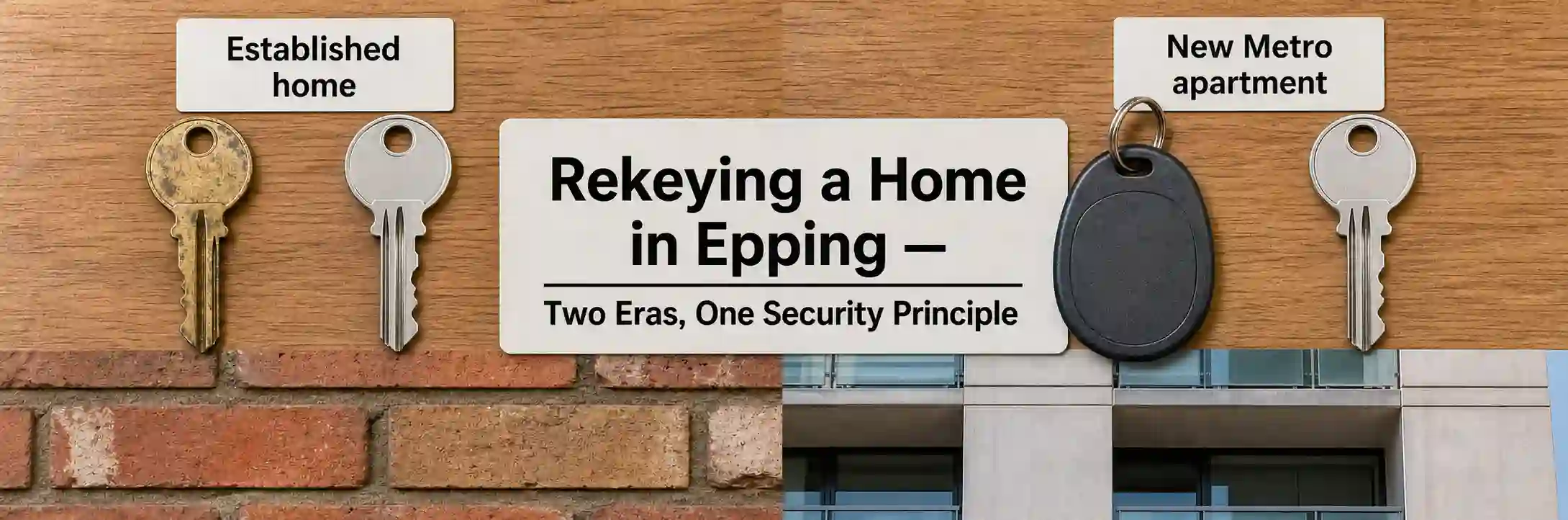
Rekeying a home in Epping is the security action that applies equally to two very different housing types that now coexist in the suburb. The established brick veneer family home that a professional Chinese or Korean family purchased in Epping’s leafy residential streets carries decades of key history from previous owners. The new Metro Northwest apartment that was completed two years ago and has already had two tenant groups carries a key history that is shorter but more actively distributed. Rekeying a home in Epping addresses both — because the security principle is the same even when the hardware context is completely different.
Rekeying an established Epping family home
Rekeying a home in Epping for the suburb’s established housing stock — the brick veneer homes of the 1960s, 1970s, and 1980s that make up the large majority of Epping’s 75.18% Environmental Living zone — addresses what decades of family occupation in one of Sydney’s most tightly held professional suburbs accumulates in a key history.
An Epping home that has been in the same family for twenty years has distributed keys to adult children who have since moved to Chatswood or Parramatta. To the trusted neighbour who collected mail during family holidays in China. To the gardener who comes fortnightly. To the housekeeper. The rekeying on settlement day — or any time a significant household change occurs — closes this history and starts the documented count fresh.
For established Epping homes: the rekeying should be accompanied by the push test on every external door. Epping’s brick veneer homes from the 1970s and 1980s have strike plate screws that have cycled through forty or fifty years of Sydney’s Upper North Shore climate.
The annual rainfall and humidity of Epping’s leafy residential setting produces a consistent timber frame moisture environment that loosens screws over decades. The push test result on many Epping homes from this era — engage the deadlock and push firmly at the lock position — reveals frame flex that the reinforcement step on the same locksmith visit addresses.
Rekeying a new Epping Metro apartment
Rekeying a home in Epping for a new Metro apartment follows a different sequence but the same principle. For a new Metro apartment purchased from the developer:
- Ask the developer or property manager specifically whether the individual apartment cylinder was rekeyed at practical completion, separate from any building-level rekey
- If the answer is unclear or negative: arrange the rekeying before the first overnight stay in the apartment
- Confirm the building’s master key system specification with the strata manager before engaging any locksmith
- Request restricted blank cylinders — the new Epping Metro apartment starts with a documented zero-baseline key count from the rekeying date
For a new Metro apartment being rented: the written lock change request before signing the lease is the specific pre-lease action that most effectively secures the property manager’s consent. An Epping Metro apartment property manager who manages multiple units in the same building receives this request regularly and is equipped to facilitate it efficiently when it is made professionally and before the lease is finalised.
NSW tenancy rights for Epping renters
Rekeying a home in Epping for the suburb’s rental community follows the Residential Tenancies Act 2010 NSW. Written request before signing. Written consent before any locksmith is contacted. A copy of the new key provided to the landlord. For strata apartments: the master key compatibility call before any cylinder is selected. NSW Fair Trading provides guidance in Mandarin, Cantonese, Korean, and many other languages at fairtrading.nsw.gov.au. For Epping’s Chinese and Korean rental community, these resources are available in the community’s primary languages.
The three LGA confirmation for Epping properties
Rekeying a home in Epping requires knowing which LGA governs the specific property, because any visible external security modification beyond the rekeying itself — a new gate, a security screen, a camera system — is subject to the planning framework of the applicable council. The City of Parramatta, the City of Ryde, and Hornsby Shire have different LEPs and development control plans.
A fence modification permissible without a DA in the City of Parramatta’s section of Epping may require a DA in the Hornsby Shire section, or vice versa. The NSW Land Registry property certificate confirms the LGA for any specific Epping address.
For the rekeying itself: the LGA confirmation does not affect the rekeying process. Rekeying a cylinder, installing a restricted blank cylinder, or reinforcing a strike plate are routine maintenance actions that do not require council approval regardless of which LGA the Epping property is in. The LGA matters for any modification that changes the external appearance of the property — which is not part of a standard rekeying.
The restricted blank and long-term key control
Rekeying a home in Epping with restricted blanks is particularly important for the suburb’s professional family community, whose household composition changes in specific and predictable ways over time. As children progress through Epping’s schools and eventually move away for university or employment, the key count for an Epping professional family home changes. Each departure should trigger a key review:
has the departing child’s key been retrieved? If not, is a rekeying appropriate? Restricted blanks mean that any informal copy made during the child’s time at home cannot be used after the key is handed back, because no hardware store copy exists. The key count is what it is documented to be.
Rekeying a home in Epping for properties in the City of Ryde or Hornsby Shire sections of postcode 2121 — rather than the City of Parramatta section — follows the same NSW tenancy and strata law that applies across the entire postcode, but with the relevant council’s LEP governing any external security modification. The City of Ryde Local Environmental Plan 2014 applies to Ryde-section Epping properties.
The Hornsby Shire LEP 2013 applies to North Epping (Hornsby section). Both are available through the NSW Planning Portal. For the rekeying itself, neither LEP is relevant — routine maintenance requires no council planning input.
The City of Ryde and Hornsby sections of Epping
For first-home buyers purchasing in Epping’s Metro apartment market: the NSW Government’s first home buyer stamp duty concession and the First Home Owner Grant (FHOG) may apply to new Epping Metro apartment purchases. The eligibility conditions and the specific concession values are confirmed through the NSW Revenue website. The security investment of a settlement-day rekeying with restricted blanks is a modest addition to the settlement costs of a new apartment purchase that provides ongoing security value throughout the ownership period.
Rekeying a home in Epping for new Metro apartments has a specific timing consideration from the development pipeline. Epping’s apartment development pipeline — driven by the Metro Northwest and the TOD planning controls — means that new buildings are completing and being occupied on an ongoing schedule.
For purchasers who are buying off the plan in Epping: the rekeying timeline starts at settlement, not at contract signing. The off-the-plan purchase period — which may be one to two years between contract and settlement — is the period during which the building is under construction and during which construction keys are in use. The settlement-day rekeying is the action that occurs at the end of this period, when the apartment is legally transferred to the purchaser.
The Epping Metro apartment and rekeying timeline
Rekeying a home in Epping connects the suburb’s two residential eras — the established professional family home and the Metro-driven new apartment — through one consistent security principle. The key history that a Victorian Balmain terrace accumulates across 150 years is a different scale from the key history that an Epping Metro apartment accumulates across two tenancy cycles, but both require the same response: a rekeying with restricted blanks that starts the current household’s documented key count from a known date. In Epping, the three-LGA confirmation and the master key compatibility call are the specific additions to the standard rekeying process that the suburb’s particular planning and building context makes necessary.
Conclusion
Rekeying a home in Epping addresses two very different housing types with one consistent security principle. The established family home’s settlement-day rekeying with the push test reinforcement on fifty-year-old timber frames, and the new Metro apartment’s builder key history confirmation and strata master key compatibility call, are the specific forms the same principle takes in Epping’s two-era residential character. Restricted blanks for both, and the three LGA confirmation before any external modification, complete the Epping rekeying picture.