
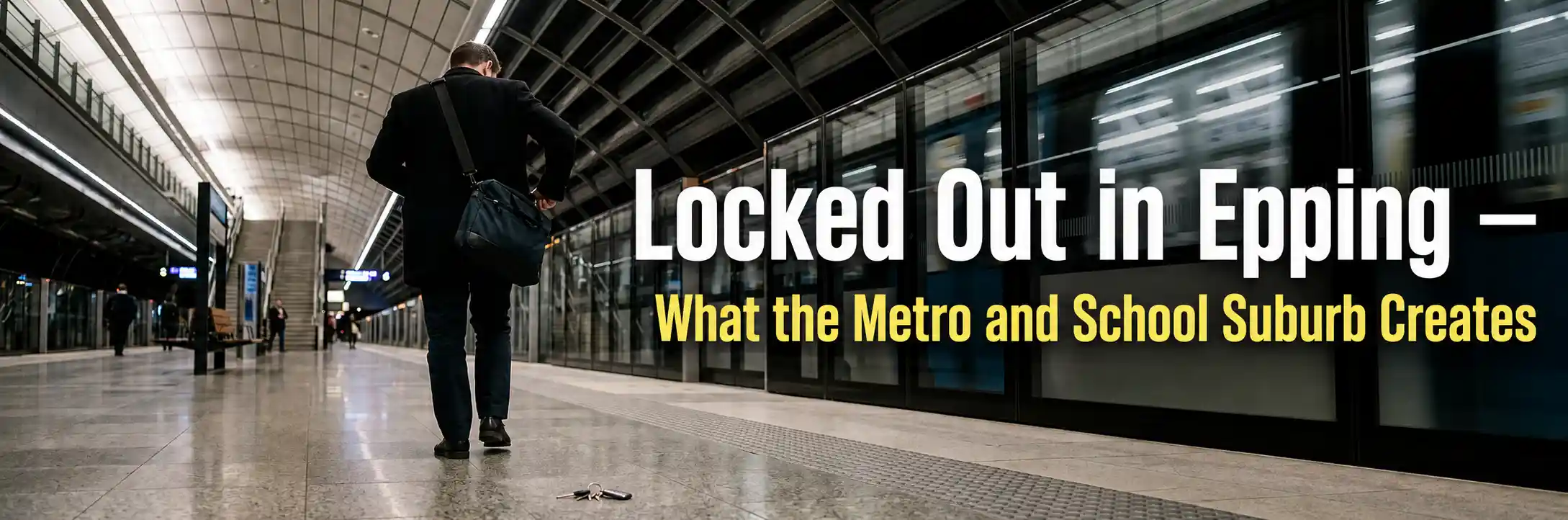
Being locked out in Epping has a specific character that reflects the suburb’s two defining features: the Sydney Metro Northwest station that transformed Epping’s transit profile from 2019, and the strong school community that makes the suburb’s after-school hours as busy as the morning commute. Locked out in Epping is shaped by the Metro commuter who discovers the key is inside after stepping off the metro at Epping Station, and by the parent who returns from the school pickup run to find the door will not open. These are the Epping lockout scenarios — not the beach visit lockout of Bondi, not the ferry commuter lockout of Balmain, and not the tuition-parent lockout of Eastwood, but the specific suburban family situations that a walkable, Metro-connected, school-oriented suburb like Epping creates.
The Epping Metro Station commuter lockout
Locked out in Epping for the suburb’s Metro commuters — Epping Station is on the Sydney Metro Northwest, providing direct service to Chatswood, North Sydney, and the Sydney CBD — is the Metro-transit lockout that is specifically Epping’s version of a commuter lockout. The departure from Epping in the morning on the Metro to Chatswood or Wynyard is a faster and more seamless transit experience than a suburban train service — the Metro’s frequency and the absence of the platform-to-train gap that traditional trains have means that the Epping Metro commuter boards and alights quickly, in a routine that becomes very automatic.
The morning Metro departure routine is the lockout risk moment: the key that was going to be grabbed from the hook by the door, the key ring on the kitchen bench, the wallet-and-phone-but-no-key-ring exit that the Metro commuter’s speed facilitates. Discovered at the front door after the Metro return in the evening.
For the Epping Metro commuter lockout: the same resolution sequence applies as for any transit suburb commuter lockout. Another household member home — Epping’s 3-person average household means this is often possible. The property manager for renters.
A trusted neighbour with a confirmed spare key. A locally-based Epping or Hills District locksmith as the final step. The preparation that makes this fastest: a trusted Epping neighbour spare key arrangement established before the first Metro commute.
The school pickup lockout in Epping
Locked out in Epping after the school pickup is the specifically Epping family lockout. The school pickup from Epping Public School, Epping West Public School, or the bus route from Epping Boys High School in Marsfield creates the same lockout scenario that school suburbs across Sydney produce — but with Epping’s specific character. A Chinese or Korean Epping family parent who collects children from school and returns home to find the key was left inside is in the school pickup lockout with the Epping community’s specific resolution resource: the school parent network.
Epping’s school communities are among the most tightly connected in the suburbs covered in this guide series. The Chinese and Korean parent community that has been established in Epping across two generations of school attendance has community WeChat groups, established carpool relationships, and the kind of mutual familiarity that means another school parent who holds a spare key is not a hypothetical suggestion but a genuine immediate resource. The school pickup lockout in Epping, in a suburb with this community character, is among the most naturally resolvable of any lockout scenario in this guide.
The Epping to Eastwood and Carlingford North lockout
Locked out in Epping for residents who regularly travel to adjacent suburbs — particularly Eastwood to the south-east and Carlingford North to the west — has a lost-key-in-adjacent-suburb dimension that the suburb’s walkable character and proximity to multiple surrounding residential areas produces. A key lost at Eastwood’s Korean BBQ strip or at the Carlingford Court shopping centre while visiting from Epping is a lost key in an adjacent suburb whose lost property pathway follows the relevant venue rather than Epping-specific resources.
The three-LGA split adds a specific lost-property-reporting dimension: a key lost in a park or reserve may have been found and reported to different councils depending on precisely which Epping area the park is in. City of Parramatta, City of Ryde, or Hornsby Shire council parks management is the relevant contact for found items in reserve areas — and the specific council managing a particular park can be confirmed quickly through the NSW Land Registry or by the park’s visible signage.
The North Epping lockout distinction
Locked out in Epping for residents of North Epping — the separate suburb that shares the 2121 postcode but is governed by Hornsby Shire Council rather than the City of Parramatta — has a specific distinction worth noting when booking any service. North Epping is a leafy, bushland-adjacent residential area that is geographically distinct from Epping’s Metro-station-adjacent commercial and residential precinct. A locksmith dispatched for a “2121” address who navigates to North Epping rather than Epping station area (or vice versa) may have a significantly different travel time. When booking, specifying “Epping” or “North Epping” explicitly, with the street address, ensures the correct navigation.
After the Epping lockout
Locked out in Epping and resolved: the Epping-specific preparations that prevent the next one. The school community spare key arrangement — a trusted school parent family whose home is on the way from the school to the lockout address, established before the school year begins.
The Metro commute spare key habit — a key left with a trusted neighbour whose availability in the evening is confirmed before the first Metro commute begins. And the locally based Epping locksmith number saved in the phone, because the professional family in Epping who has the locksmith number before needing it is the family that resolves the next lockout in thirty minutes rather than ninety.
Locked out in Epping for the student rental community near Macquarie University — the large university campus in the neighbouring suburb of Ryde that is easily accessible from Epping Station on the Metro Northwest — creates a specific student lockout profile. Students who rent in Epping for its transit proximity to Macquarie University have the same share-house key management complexity and the same high-turnover rental key history that student-adjacent suburbs produce.
The written lock change request before signing, the move-in condition report, and the designated spare key holder are the specific preparations that student renters in Epping benefit from as much as the professional family community.
Epping’s proximity to Macquarie University and student renters
Bus lost property for services in the Epping area: Transdev NSW operates bus routes in the area. Items found on Transdev services are reported through Transdev’s lost property process. A same-day report gives the best recovery chance before found items are transferred to the central facility. The specific bus route number helps locate the found item more quickly than a general suburb report.
Locked out in Epping for families with students at Epping Boys High School — located in Marsfield, requiring bus travel from Epping — has a specific secondary school transit lockout dimension. A student who takes the bus from Epping to Marsfield for school and returns in the afternoon to an Epping home where both parents are still at work has an independent after-school access requirement that is the key management challenge.
The key for an Epping Boys High student should be a documented restricted blank key — so that a key lost on the bus to Marsfield is on a profile that cannot be informally copied — and the household should have a confirmed spare key arrangement with a trusted neighbour or family member for exactly the situation where the student returns to find their key was lost on transit.
Epping Boys High School and the secondary school lockout
The Epping lockout that has been resolved is the one that cost time, inconvenience, and perhaps a locksmith call. The one that did not happen is the one where the school community spare key was in place before it was needed, where the Metro commute preparation included a trusted neighbour arrangement, and where the locally based Epping locksmith number was saved on the first day of residence.
In a suburb with Epping’s community character — the Chinese and Korean professional families who know each other through school and community connections — the spare key arrangement is the most naturally available lockout prevention of any suburb in this guide. Building that arrangement is worth the ten minutes it takes.
Conclusion
Locked out in Epping reflects the Metro suburb family character — the Metro commuter morning departure lockout, the school pickup return lockout, and the three-LGA geography’s impact on lost property reporting and locksmith navigation. The school community spare key, the Metro commute preparation, and a pre-saved locally based Epping locksmith address all three before they become the situation.