
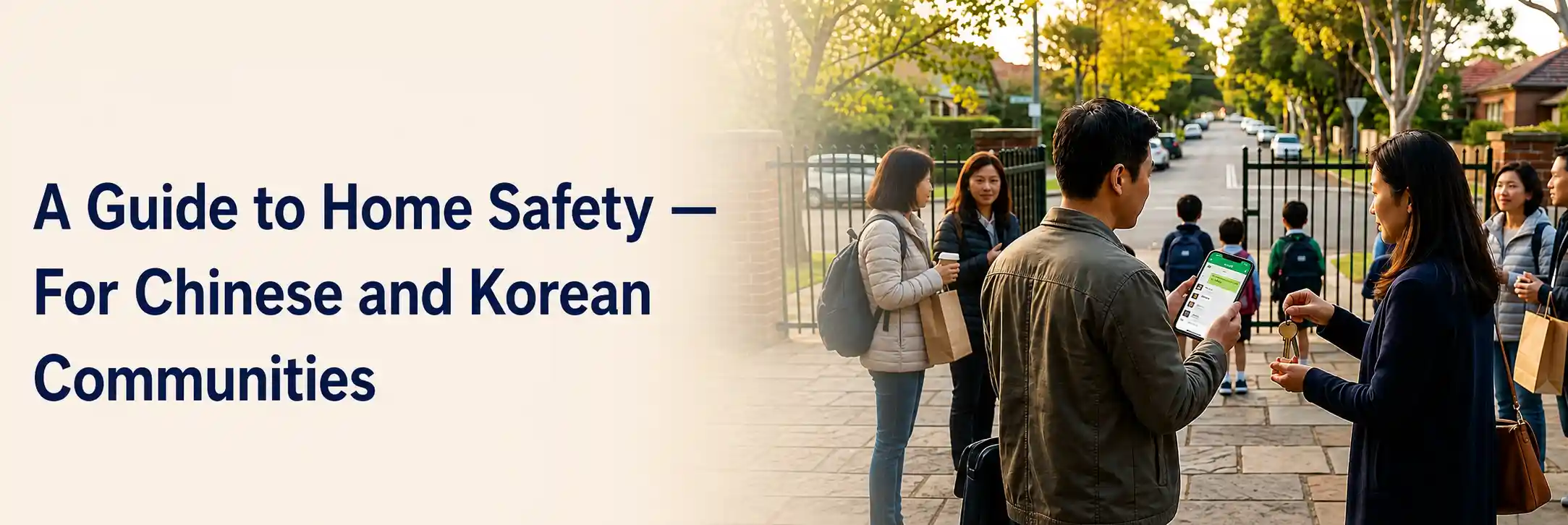
Home security in Epping reflects the suburb’s multicultural character in specific ways. Epping has China as the most common overseas birthplace among its residents, and a significant Korean-speaking community alongside the Chinese community. The Epping Chinese and Korean community is, however, distinctly different in character from the Eastwood Chinese and Korean community covered earlier in this guide series.
Where Eastwood’s Chinese and Korean community is characterised by young professional couples without children purchasing for school catchment access, Epping’s Chinese and Korean community is more strongly family-oriented with children — the suburb’s average household size of 3 people and the couple-with-children dominant household type reflect a community that is established, professional, and deeply invested in the residential neighbourhood as a family environment rather than a purely investment or lifestyle decision.
The Epping school community and key management
Home security in Epping for Chinese and Korean families reflects the suburb’s strong school catchment character. Epping is served by Epping Public School, Epping West Public School, Epping Heights Public School, Epping Boys High School in Marsfield, and Arden Anglican School. The school community creates the same after-school independent access key management requirement that Eastwood’s school community creates — each in its own character.
An Epping Chinese or Korean family home where one or more children walk home from Epping Public School or ride the bus to Epping Boys High School in Marsfield independently needs a documented key for each child with regular independent access. Restricted blank cylinders from the rekeying ensure that the school-age child’s key cannot be informally copied — the child who loses a key at school has not compromised the property’s security beyond the need to rekey.
The annual review of the household’s key count — who holds which key, and whether the current key distribution reflects the current household arrangement — is the maintenance practice that keeps the Epping family household’s key management current as the children grow and their access patterns change.
The professional household and Epping home security
Home security in Epping for the suburb’s professional community — Epping has almost double Sydney’s average proportion of professional occupations — has a key management and hardware quality dimension that reflects both the household’s financial capacity and its risk awareness. Professional families in Epping who have invested in a property in one of the suburb’s most established and leafy residential streets are households that have the means to specify hardware that matches the property’s value.
The push test and key feel assessment that form the starting point for any security assessment are appropriate regardless of the household’s professional standing. A 1970s Epping brick veneer family home may have the same strike plate fatigue as any other established home regardless of the household’s income.
The professional Epping family’s advantage is the awareness to commission the assessment and the financial capacity to address what it finds — not any inherent immunity to the hardware wear that decades of Sydney’s climate cycling produces.
NSW tenancy rights for Epping’s Chinese and Korean renters
Home security in Epping for the suburb’s renter community — Epping has a significant rental market for both the new Metro apartments and the established houses that are rented while owners build investment portfolios — involves the same Residential Tenancies Act 2010 NSW rights as any NSW tenant. NSW Fair Trading provides guidance in Mandarin, Cantonese, Korean, and many other languages. For Epping’s Chinese and Korean rental community:
the written lock change request before signing the lease, the written consent before any locksmith is contacted, and the move-in condition report within three business days are the three specific actions that protect both security and bond from the first day of occupancy.
For Chinese and Korean Epping families who are purchasing rather than renting: the settlement-day rekeying is the security action that closes the previous owner’s key history. An Epping professional family that purchases an established home in the suburb’s leafy residential streets has bought into a housing stock that may carry decades of key distribution history from previous families. The rekeying closes that history and starts the new family’s key management with a documented, zero-baseline count.
The Epping Chinese and Korean community network
Home security in Epping benefits from the genuine community connections that the Chinese and Korean communities have built in the suburb. The Epping community networks — through the local schools, through community organisations, and through the daily social connections of a suburb whose Chinese and Korean residents have been here long enough to know each other and their neighbourhood well — provide the natural surveillance and trusted neighbour infrastructure that hardware security complements.
An Epping Chinese or Korean household whose neighbours have been in the same street for fifteen years, who recognise each other’s cars and children, and who are genuinely connected through the school community has a natural surveillance asset that is stronger than in a more transient suburb. The spare key arrangement with a trusted neighbour — so central to the lockout prevention conversation across this guide series — is most naturally available in communities with this level of genuine familiarity.
Epping’s three LGA context for community security
Home security in Epping for the suburb’s Chinese and Korean community has a specific administrative context from the three-way LGA split. Different parts of Epping are governed by the City of Parramatta, the City of Ryde, and Hornsby Shire — three councils with different planning frameworks, different community programs, and different council services. For Epping Chinese and Korean residents who want to access council multilingual services or community programs: confirming which council governs the specific property address is the first step. The NSW Land Registry property certificate confirms the LGA, and each council’s website provides specific community services information.
Home security in Epping for families associated with Arden Anglican School — the co-educational independent school on Marsden Road that was formerly Our Lady of Mercy College and that draws students from across Epping and the surrounding Upper North Shore suburbs — has a specific school community character. Arden Anglican’s broader geographic catchment means that Arden families in Epping have school community connections across multiple surrounding suburbs.
The spare key arrangement for an Arden family home in Epping is naturally positioned within the Arden school community network — a family whose children attend Arden together is a family whose properties are in the same geographic area and whose mutual familiarity is built through the school.
Arden Anglican School and the Epping school community
The same community information network that makes the Epping Chinese community’s locksmith recommendations specific to the suburb also makes security awareness information circulate effectively. A security incident in an Epping residential street that is discussed in the local Chinese community WeChat group reaches hundreds of Epping Chinese residents quickly, producing a community awareness response that is specific to the suburb and the specific street rather than the generic security advice that media coverage provides.
Home security in Epping for the suburb’s Chinese community benefits from the WeChat community networks that are active in Epping as they are in Eastwood. Epping’s Chinese community WeChat groups — organised around school communities, local area interests, and family networks — circulate practical local information including experiences with local tradespeople and service providers. For Epping Chinese families considering a locksmith or security hardware upgrade: the local community WeChat network is a genuinely useful research resource for suburb-specific recommendations that generic review platforms do not provide.
The Epping WeChat community and security information
Home security in Epping for the suburb’s Chinese and Korean professional family community reflects what makes this community genuinely distinctive. These are families who have chosen Epping not for its investment return or its lifestyle amenity alone, but for the specific combination of school quality, professional community, leafy residential character, and transit connection that no other Sydney suburb offers in exactly the same combination. The security of the homes in which these families have built their lives in Epping deserves the same careful assessment and proportionate action that the community brings to every other significant family decision.
Conclusion
Home security in Epping for the suburb’s Chinese and Korean professional family community reflects what makes Epping distinctive from Eastwood — the family-oriented professional households, the strong school community network, the established residential character alongside the Metro-driven new apartment stock. The push test, the rekeying with restricted blanks, the documented key count, and the trusted neighbour spare key arrangement — supported by the Epping community’s genuine social connections — provide the security foundation appropriate for this community.